The Meaning of Masterpiece

When considering the canon, that is, the body of masterworks that a given culture treasures, it is worth considering what exactly makes a masterpiece, and indeed why the masterpiece has such a powerful influence, why it is more than a mere artwork. For literature, for example, aspects such as linguistic virtuosity, emotional depth, psychological ‘realism’ (as in insightful,
not strictly realistic), thematic complexity and depth, as well as a clear and interesting engagement with not only other works of literature, but also many aspects of life (be it
philosophy, history, science, psychology, and so on), are all what I would consider to be uncontroversial characteristics of the literary masterpiece. However, all of these are irrelevant
to the true and central characteristic of the masterwork, which is namely a kind of paradox, a miracle, whereby the work of art excels to such a degree that it attains a perfection so
peculiar, so specific to itself, that it thereby transcends being a work of art and becomes something else, taking on new life, and yet it remains confined to what it is, a mere artwork.

If you were to visit any local art gallery, you would be met with paintings that are certainly varied in form and subject matter, but the one defining aspect of these artworks is that they
are in fact just that, artworks. When I stroll through a room in such a gallery, I am not particularly interested in the form, subject matter, or theme of these works. Of course, I can
certainly recognise these aspects, recognise that this is a religious painting, this is a history painting, this one uses a particular technique, that this looks like a painting from a
particular period or movement, and so on. Yet the one thought that endures through such a visit and shortly after is the fact that these paintings are just that, paintings. They are so
perfectly captured by their bare definitions that they almost seem like platonic ideals: when I see a bowl of fruit on a canvas, I feel like I have seen every still life that has ever been
and ever will be produced. There is something almost sublime in a work that is so average, being so devoid of particularness that it almost seems to encompass all other similar works at
once, and yet it is so confined to being what it merely is, a very unremarkable work of art, one of many thousands upon thousands that have been produced over the years.

In considering such works, it allows us to understand what I think is the defining aspect of the aesthetic, namely the experience of a paradoxical state in which the work of art
simultaneously escapes from and is crushed under the bare definition of what it is. Of course, this applies to virtually any kind of experience, but it is felt most powerfully with art.
The crucial difference, however, between the mere artwork and the masterpiece, is the latter’s ability to successfully escape its bonds, to let slip its definitions, to run free and revel
in an entirely new space, filled with a new life, and yet remain bound to the canvas and the page, bound to the forms, themes and conventions in which all other works of art partake. Great
art, indeed, is not driven by concerns of beauty, instruction, legacy, or whatever else. It is defined by the attempt to demonstrate a particular kind of event, namely the miracle in which
something attains such perfection that it simultaneously acts as the ideal of a particular type of thing while at the same time going beyond the definitions of that very same type of thing.
I would argue that this miracle should not only stand at the heart of any kind of ethic, but art is the primary means by which we bear witness to this miracle, and that therefore art’s
primacy should be advocated for endlessly in the face of all contenders.

Of course, scoffing in the face of aesthetes is certainly justified. I have always felt there is little difference between the men sitting in the terrace and the opera box, and I have
always detested that self-importance associated with ‘good taste’. Pleasure should be no guide, and neither should mores, convention, and least of all ‘taste’, which really translates to
conditioning. Anyone even half-familiar with the canon would know its diversity, a motley crowd both bawdy and chaste, zealous and blasphemous, much like the audience that presumably sat
(or stood) watching the first performances of Shakespeare’s Hamlet. Fat old men look down on the young who mope through readings of that very same play, totally ignorant as to why they
could not care less. It is because they do not care for anything at all, least of all old books. But who is to blame for such apathy? I don’t need to answer that.

Regardless, what is at stake here is not the revival of these works (for they shall live forever), but rather reviving ourselves, specifically our sense for these works and their
centrality to life. But it is not a moral or intellectual revival. Indeed, it is not even an experiential revival, but rather a recognition of the central importance of the miraculous
phenomenon outlined above. Furthermore, I would argue that any and all perception of artistic inertia or failure is tied to fewer occurrences of this very same phenomenon. If we consider
the frontiers spied out in the previous century, who would disagree that they have already been surveyed and populated with chattering wagon trains? Rock was the sound of half a century,
but who would disagree that its last hoorah was in the 1990s, and that the genre is now populated by curators and ‘taste-makers’ whose merit derives mainly from their sound
‘recontextualising’ (whatever this means) works made several decades in the past. The finest antiquarians of today are to be found in the metal and punk scenes; if it wasn’t for curious
youths in search of personalities, a hardcore gig would more resemble a family gathering of 40 year old men in cargo shorts fondly staring at the latest shade of loud on stage as if it was
a finely made copy of their dear departed mother’s fine china.

I have already indicated my disdain for convention, but even I must acknowledge it is somewhat mortifying to claim video games as the latest frontier (despite this being completely true).
Yet even here do we catch the long sigh of fixed forms, devoid of that miraculousness so crucial to art’s restoration of life. Anyone even vaguely familiar with the medium would be aware
of its golden age stretching somewhere from the mid 1980s up to the late 2000s, a period in which a single game could represent a technological leap or genre innovation so substantial, so
significant as to influence the rest of the industry. Entire genres and franchises were birthed (or at least revived) when a San Mateo studio released a certain hack-and-slash dungeon
crawler in early 1997, despite the prevailing sentiment at the time being that RPGs were dead. One of the finest stories in the medium centres around a certain Maryland studio in the late
1990s who, on the brink of failing as a business, determined to produce a sequel to its main series that constituted not only a return to form, but a deliberate progression in terms of
technology and design that acted as the blueprint of virtually all open-world games from that point onwards. To think that the former studio is no longer with us, and the latter is
currently wallowing in the murk of its own goodwill, while others play with the rubble they chipped off the edifice that was that magical release of 2002.

In answer to accusations of nostalgia, I say only that it is undeniable that these formative periods of art (for example, the 1970s and 80s for punk and metal, the late 1990s-early 2000s
for Western RPGs) stand apart mainly due to the miraculous character of their creative output, that is, they were periods in which artists produced numerous works which align with the
joyful paradox of the masterpiece. This is plainly evidenced by the fact that such works are still used as the primary reference point for artists working within these genres and mediums
today. Many of these artists today produce great works, but a work being great is not enough to warrant the label of masterpiece. Indeed, a work may excel in every way (including in the
ways that literary classics excel, as outlined above), but as should be obvious by now it is not the quality of a work, nor its beauty or morality, but rather in the way it breaks its
definitions and takes on new life that makes an artwork a masterpiece. In answer to accusations of obscurity, I say only that I cannot, indeed could not offer an answer. As should be
obvious by now, I have used the word ‘miracle’ and ‘paradox’ several times now to underline that what lies at the heart of the masterpiece is the unintelligble. The effect of the
masterpiece is comparable to that of the ‘thing-in-itself’ and its associated phenomena: I can experience this thing, this work of art, and feel that lying behind, beneath, or within it is
a life or will that with one coy glance could root me to the spot, a joy that generously allows itself to be fixed to the dimensions of the work while constantly breaking free to delight
itself with unknown dances under nameless skies. For a moment, we can catch glimpses of this joy and its world, and yet we are always rudely expelled with nothing but an invitation to
return. It is exactly this invitation which should stand at the heart of any ethic, and indeed proves the need for art to justify life, or at the very least offer a curative. I will not
recommend it as the object of hope, but I will say that the masterpiece, specifically the experience of the masterpiece as miracle, as paradox, as bounded yet boundless, as dead object and
living subject, as simultaneously the ideal yet transcending that ideal, should sit at the centre of our thoughts and deliberations, and that we should live to experience such works in
order to become like them, that is, to become so perfectly human that we would be both ourselves and more than ourselves, to take on new life while remaining completely the same. But I will
leave the mechanics of such an ethic for another time.
The Adventures of Hel and Edin, Chapter III

Chapter III

There were five of us. Well, there were really four of us, and one who had been slowly diminshing for several hours. He was somewhere between a half and three quarters.

‘Please…I know nothing more!’

It was difficult to tell whether it was his flesh, blood, or simply his spirit that was being extracted with agonising care. The light in the room was dim. If any hunks of fat were hewn, or pints of blood drained, you could not smell it. The room hummed with monoclean solution and preservatives.

‘Why…I have told you everything!’

The two fiends in white skin-tight suits seemed less convinced. What Edin’s opinion was I could not tell. He had resigned himself to studying a nearby wall.

‘We are not satisfied. Neither is our lord.’
‘What…what need I say?’
‘May we suggest recounting your testimony again?’
‘What use is that? There is nothing left to utter!’
‘There will be nothing left of you should you refuse.’

I could see more clearly now. The man hung in the air like a planet in the void, and it seemed as if a pair of cosmic tyrants were carving mountains or draining oceans before the whole sphere gave way. Nevertheless, the man summoned what little strength he had left, and began to speak as suggested.

‘It…it is true, I visited the household on the day. I spoke to your lord, Gods keep him!’
‘What did you speak of?’
‘He…my lord complained of the trespass his manor had suffered during the night of a performance.’
‘The stagehand. Suprisingly resistant, that one.’
‘I assured my lord that what the boy had told you was nonsense, that I had not paid him to scour my lord’s home.’
‘…If only there was more of you to take.’

The man shivered, as if the sphere had suffered a quake.

‘We would not have discovered the trespass, had we not checked the boy for anything priceless. Had he not seized that bag of coins, for which he could not hide his joy, he would have
escaped us. Of course, by the time we had seized him, he had already told you everything.’
‘…Yes.’
‘We would have gladly taken you into our care, had our lord not been placated by your words. At least we can enjoy you now.’
‘Please…please, I did not know! They paid me, yes, but they assured me the house was to be burgled!’
‘You believed them as easily as our lord believed you. To think we could utter his name with yours in the same breath…’
‘But…But I told you who it was, who approached me! It was that devil, Deircun! He has been my shadow for months!’
‘This Deircun…He is a thief?’
‘And worse, surely worse! He is the one behind this, not me! He is the one who paid me to search this house! He still hangs about my troupe even now! Go to him, seize him, kill him,
just restore me! You promised me you could!’
‘…Of course we shall restore you, we shall return everything…’

A few minutes worth of counsel was required to confirm our plans, and with Edin’s nod, the whole household emptied into Majoree. The household was ringed around the two of us as we trudged
towards the grounds of Prolik Tram-El’s troupe. The night was old, but the streets felt new, refreshed with the barks of our guardsmen, who kicked dog and beggar alike to make way for our
band. Torches and fire-sticks were thrust into the sky, as if to mock those specks which could only watch as one of their own burned through the city. As difficult as it was to speak,
owing to the surly din that surrounded us, I did manage to sneak a few words to Edin in the midst of our march.

‘Do you believe him? Surely this Deircun would have escaped after the deed was done, along with any evidence. Perhaps Prolik expected this, perhaps an ambush awaits us…’
‘What else are we to do? Ambush or not, Prolik’s words are all we have.’

Edin’s words offered slight comfort. As much as he and our mob seemed to burn bright with vengeance, the city was unmoved. It felt like at any moment, one of the crumbling clay walls would
surely fall and snuff us out, and the stars would laugh at their brother who descended to earth, our rage now smoke that wafted to heaven for them to savour. I did not regret making my oath
to him, nor did I regret setting out this night. But with each new step, I felt more and more like my father surely felt, a paper man from a paper tribe, only half-eager to rise, half-keen
to float on the smoke that rose from this blaze that called itself House Cormyk.

‘Halt! We near the place. Hasik, Lorel, scout ahead! Our lord will have Deircun in his grasp tonight.’
‘Let me go with them! I would see this place.’
‘My lord?’
‘…Hel may go, if he wishes it.’

But despite, or perhaps because of my hesitance, I resolved to show my worth, and set out with two of the men. If the stars did laugh before, they were silent now, as we soon came within
view of such murk that could drown the sky. It seemed like all the world’s scum had floated here, and it was difficult to keep up as we darted past tents and wine vats in search of Deircun.
Backstabbers gave lectures to failed neophytes, whores would haggle which part of their flesh they would surrender to slumming sons of consuls, and all of them alike would then sit on pews
upon pews, dribbling into cups, and heap hope upon hope for a new fancy to sate them. I confess that I came to close to losing my stomach, as my nose was jostled by scents of sick that
gave way to frightened sweat streaked with blood. With a glance you could see many a world splutter into being, hang in the air, then be lost forever, like so much spilled beer. It was not
a few times I saw a life taken for exactly that, though I could not understand why, for their brew looked like piss.

‘You two, listen! I overheard some rogues mention Deircun. His tent lies on the edge of the encampment near the river. Lorel, report this to our lord.’
‘What would you do?’
‘Hel and I will approach the tent. It may be he is not here, but we will determine that. Go, now!’

From there we crept, and soon confirmed what had been overheard. The tent seemed fit for the tyrant of this place, and I assumed that Deircun must be a short man. What did not seem fit was
the sheer quiet; where were the guards, or fawning courtiers?

‘Hel…It is strange…I do not like this, but we must approach.’
‘Shall we take him?’
‘Yes. By now our lord and the men will be falling on this place, we must seize Deircun before he has the chance to escape.’

We drew our knives and came to the threshold. Within lay the spoils of his trade, old bits of gilded furniture strewn with coins and gems, all painted a dull red-grey from a waning candle.
There was no Deircun inside.

‘Where could…?’

An answer came in the form of blades pressed to our necks.

‘Deircun, look here! These would go well with the other one!’

We were dragged before their lord who stood regal in a tablecloth cape, milk white stiletto caressing the neck of Lorel.

‘You’re right! Quite the prize…no doubt they’ve skulked their way from the Cormyk place. We’ll away before the rest of them come, but not before giving sweet mother Earth a taste of their
blood…’

A stroke of the hand, a whisper, and Lorel’s life began to pour onto the ground. He had no voice to scream, so I screamed for him. A swift hand across the mouth cut that short.

‘Did you enjoy that wail? It is the last thing you will utter. Bring the other one forward, I want this one to watch…’

Another stroke, even quieter, and Hasik’s life began to pour onto the ground.

‘Now the last one…’

As I knelt there with Lorel and Hasik’s blood ready to join mine in one swift stroke, I saw shades rise from the shadows. I thought I was already dead, but the flashes from their
firesticks proved otherwise.

‘What!?’

With that last utterance, the heads of the guards were blown apart, painting Deircun’s tent red, decorating it with bone. I hope they enjoyed that last word.

‘Bastards, they are upon us!’

He seized me by the neck and turned to face the men.

‘I have one of yours!’
‘We have a dragon’s worth of fire pointed at your head. Even your soul would be blasted to bits.’
‘My soul is destined for hell! You would be doing me a favour, for how could I go there without one?’

The stiletto began to prick the skin.

‘Bold words…It is a shame your eyes betray you.’
‘Be quiet! I know that I am done, but I will take this one with me!’
‘We know you were involved in the murder of our lord. We would know why.’
‘I would tell you that with those sticks aimed at me?’
‘The only way you leave this place with your life is telling us what you know.’
‘How can I trust you?’
‘You cannot. But trust that they’ll find charred bits of you in every corner of the city if you don’t.’
‘But…But this one here! You’d kill him too!’
‘What is his life compared to that of our lord’s?’

I could feel the dagger retreat.

‘…Lay your sticks down!’
‘Lay that knife down, and we will do so.’
‘Ah! You care for this one then!’
‘No. I just think it absurd for a pile of flesh to speak, let alone dictate to us. For that is what you will become, Deircun, if you do not lay that knife on the ground.’

I could feel the tickle of hesitation before Deircun decided to thrust the knife out.

‘Fine!’

Both sticks and dagger dropped to the ground.

‘Release him!’

I felt his arm give way. I ran to stand amongst the men.

‘We know you did not commit the murder yourself. To slay a Houseman, a head of house no less…no, you are too cowardly. You were only the middleman.’
‘…Yes…I was approached by one who was bent on taking your lord’s life. He payed me to survey the manor, and I fell in with Prolik’s troupe, as I knew they performed there from time to
time.’
‘You paid Prolik to provide information?’
‘I did. The oaf thought I was only out to burgle the place, little did he know…’
‘The man who paid you. Who was he?’
‘…He did not tell me his name. I did not see his face clearly, but…I believe he had tubes for eyes…He seemed to know so much about me, but he was no thief or rogue…He was cloaked,
but I could tell his clothes were not loose…he wore a suit, I think…’

A silence fell on the place.

‘What else? Tell else all you know!’
‘I know nothing else! Now let me go!’
‘No! You know more than you tell!’
‘You basta–!’

With that last utterance, the head of Deircun, thief of Majoree, was blown apart.

‘Hold! Hold your fire, damn it! There was more to tell!’
‘No one fired! Our sticks are on the ground!’

A madness fell on the men as they desperately searched the place. There was no one to be found.

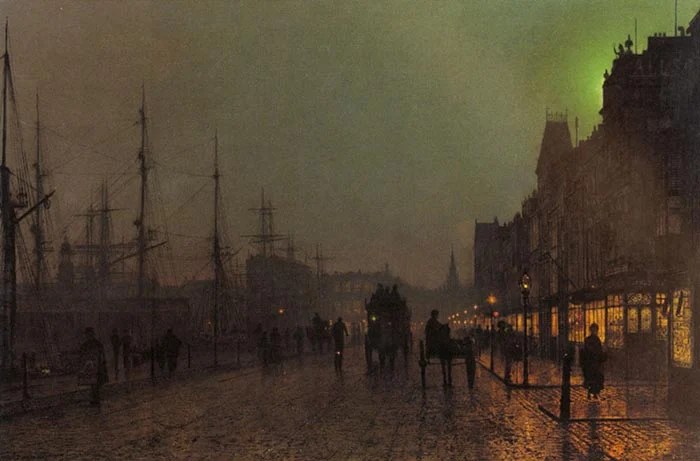
(Featured image is ‘Evening on the Pier’ by John Atkin Grimshaw)

The Adventures of Hel and Edin, Chapter II

Chapter II

Praise be to God. Salutation to the Unknown Reader.

I have quit my place at Welchin. The good Fathers informed me of my father’s death, and the suspicion surrounding it. As is my obligation, I have gathered myself up and left for Majoree,
with Hel at my side. The Fathers refused his demands to come with me, but I overruled them, invoking the Right of Assistance all Houseborn men are entitled to in times of need. We have been
granted leave to set my House’s affairs in order. We had departed Welchin via airjunk, mostly silent as the clouds painted the windows grey. The sky wore a face of dull eggshell. I hoped,
sullen as I was, to avoid a visit from my House’s spirit, at least until we arrived home. A hopeless hope, as if She would ignore me in such a moment, as if hugging the clouds would hide me from Her.

‘They will pay for what they did, Edin.’
‘I hope it does not come to that, Hel.’
‘What? Don’t you wish to exact vengeance on your father’s killers?’
‘They do not know for certain whether he was murdered. It’s solely suspicion, nothing more.’
‘You are awfully cool on this. Don’t you wish to see them burn?’
‘Whether they burn on pyres of wood or of shame, they’ll burn.’
‘You would dishonour your father by thinking so.’

I turned to stare at the face of the sky. My gut sunk as I realised the change, that slight change, which always warned of Her coming.

‘You fear what it would mean for you? What it could do to you?’

I continued to stare.

‘Listen to me. When I was eight years old, a young girl from a merchant clan was found dead and… she was found in an alleyway in the lower corner of Baramawa, where my family lives, near
a tavern. I remember the day they finally found the perpetrator. He was some mercenary from Beyond, a rock worshipper or other passing through to who knows where. They couldn’t have
tortured him for very long, since that was all that anybody knew about him after the event. They killed him, of course, in the marketplace, in full view of the district. But what I remember
most is the faces of the family as they watched. Everyone of them, father, mother, brother, all had that same face, like a burning oven shut fast, flames threatening to burst into air, but
never doing so. After we returned home, my mother, ever perceptive, furnished me a proverb that summed up the whole affair: “Vengeance may be hot, but only revenge burns.”‘

I could see Her now.

‘…I understand. I did not wish to press you on this. I will leave you alone.’

I tried to reach out to hold Hel’s leaving, but I was now helpless. I could barely hear the thin metal tap-tap of his shoes on the floor as She reached out to envelop me, the junk,
the sky, the world, the spheres, the all.

SWEET, SWEET…SWEET ONE, IT HAS BEEN TOO LONG!

yes, my lady

SWEET EDIN, HOW EVERY MEETING GLADDENS ME!

yes, my lady

SWEET ONE, REMEMBER THE COLOURS OF THE HUMDREE STALKS YOU GATHERED WHEN I FIRST PLUCKED YOU?

yes, my lady

OH, SPEAK TO ME! HOW SULLEN YOU ARE, HOW SULLEN! WHEN YOU WERE YOUNG, HOW EASILY YOU WERE TOUCHED!

i am sorry, my lady, but…

I HAVE ALREADY SIPPED YOUR FATHER’S SPIRIT AS IT WAS POURED INTO THE AETHER. HE TASTED OF VIOLENCE, CURDLE-COLD, IRON TIPPED, TOO DULL TO TASTE, TOO DULL TO SPEAK!

then, you know…

OF COURSE, SWEET FOOL! I KNEW AT ONCE, JUST AS HURI-DAD KNEW THAT HIS ELDEST HAD FALLEN AT BLUEFIELDS, OR EVEN AS GOMM KNEW WHICH OF HIS WIVES WAS FALSE.

false…you mean…

YES! FROM WITHIN, THE HOUSE IS POLLUTED! YOU MUST CLEANSE IT, SWEET, REMOVE THE CAKED BLOOD FROM YOUR TABLE AND PLACE CAKES OF LOVING-KINDNESS, HONEY DRIPPED WITH REVENGE!

then you will tell…

NO, FOOL! TO TELL IS TOO MUCH, AND FAR TOO SOON! LIKE A GROOM WHO FONDLES HIS BRIDE AT THE WEDDING FEAST, LIKE A SAILOR WHO GIVES HALF HIS LIVING TO A HARLOT WHO HALF FOROGT HIS NAME!

but where should i begin…

SEEK OUT PROLIK TRAM-EL. RAT-LIKE MAN, HEAD OF ACTING TROUPE, CAME TO YOUR FATHER’S HOUSE ON THE DAY OF MURDER, KNOWS SOMETHING, WILL TELL SOMETHING LESS. SEIZE HIM, BEAT HIM, DO AS YOU
WILL, BUT TAKE FROM HIM HIS WITNESS. HE WILL COME TO THE INTERMENT, WOULD NOT WISH TO SEEM SUSPICIOUS. WILL EVEN STAGE A PLAY IN FATHER’S HONOUR. HALF-SNEAK, BUT NOT SNEAKY ENOUGH.

but what do i…

SET YOUR HOUSE IN ORDER. PLACE YOUR FATHER’S BONES IN THE CRYPT, AND BREATHE PERFUME UPON THEM. CHANT FIVE BLESSINGS, AND EIGHT WISHES, AND TEN LOVES. SPRINKLE BUG MUSK. MIX TWO WINES, ONE
VINTAGE OF HIS BIRTH, AND ONE FRESH, OF HIS DEATH. NEED I GO ON?

no, i know these things, but…

BUT WHAT?

i am afraid

BE AFRAID. YOU WILL STILL DO MY WILL. FOR MY WILL IS LOVE. BESIDES, I WILL GIVE PLEASURES TO YOU THAT WILL MAKE PAST ONES SEEM LIKE CRUMBS CRUSHED BELOW LOVERS’ FEET. REMEMBER THE ONES,
MY SWEET, ON THE DAY OF THE HUMDREE STALKS?

yes, my lady

GOOD. REMEMBER, EDIN, THAT ALL THINGS PASS AWAY. JUST AS YOUR FATHER HAS PASSED, SO WILL YOUR MOTHER, YOUR HOUSE, YOUR CITY, YOUR NATION SHALL PASS. EVEN YOUR COMPANION, WHO I URGED YOU TO
TAKE UP IN THE HALL OF THE PNEUMATIC GOD-MACHINE, WILL PASS, THOUGH NOT BEFORE MUCH TOIL. BUT I WILL REMAIN, FLESH OF FLESH, BREATH OF BREATH, IN EMBRACING EMBRACES ALL EMBRACES.

MY WILL IS LOVE.

I could hear the tap-tap of metal as Hel and everything else was returned to me again. He was still walking away from me.

‘Hel…Hel, come back!’
‘Edin? What is the matter? Are you alright?’
‘Yes, yes, it’s just…my mind was elsewhere.’

The clouds cleared to allow the sun to shine on our home as we approached. The sprawl was soaked from the recent rains, turning mud-caked roads into brown-black veins which coursed through
the skin of the city. Temples, manufactories, living towers, all of them bumps and bruises in the holy ochre flesh of Majoree. I strained to see which patch of mauve and alloted green was
my family’s home, but I could not tell. Before long we came in sight of the Drome, the square port which hummed with the coming and going of a hundred airjunks, all of them greeted and
farewelled by statues of four city fathers which stood like fingers at the corners of the Drome, hands raised to Heaven in a gesture of blessing. I remember how the fathers looked when I
first left Majoree. Looking down on them, it seemed as if they were throwing me up into the air, like a parent playing with their child in the garden. But now, upon returning, I could see
the slightest hint of something in their faces as they readied to catch me on the way down, something like reluctance, as if they would rather I hang in the air forever. We were greeted by
a servitor upon disembarking from the junk. They told us that mother was here, and that she was waiting in one of the reception rooms close to the Crush, the main hall of the Drome. We were
fed through a hallway lined with guards who stood like red columns of cloth, save for white masks which seemed to watch us as we passed through this limbo. More than once was Hel hurried
along by a sudden whining tone which seemed to sound from them, half-man, half-automaton, like gears scraping the sides of a voicebox.

‘I cannot imagine…’
‘They gave their bodies willingly. Even after death they can still stand guard and cry.’
‘But still…’

Before long we came into the Crush. ‘All praise to that man-made river, the rainbow mass of flesh that flows like the Torr, a roar of a thousand tongues whose words spray and splash towards
the blackened vaulted ceiling. All praise to the air which swirls which a thousand stinks and perfumes. All praise to the maddening whirl of a thousand fabrics, to the eternal clash of
cloth in which new colours, unknown to man, seem to burst into life, stay but a moment, and are lost forever. Praise be to even those islands in the current, groups of vagabonds and beggars
peddling second-hand scripture and trinkets, grape-skinned and discoloured.’ I recited these needed words, taken from a chapbook gifted me by the fathers at Wilchen, as I dove into the
crowd after the impatient servitor. More than once did I lose Hel only for him to appear ahead of me, almost clinging to the servitor like a drowning man grasping at flotsam. I couldn’t
help but feel a kind of calm as I let the current half-take me, half-wanting to let go and be lost in it, knowing what lay ahead. Eventually we reached the other side of the hall, were fed
into a corridor, and arrived at the reception room where my mother awaited. Hel gave me a knowing look as I entered alone. My mother was not there.

‘Please, be seated.’

In place of her was a man, sitting on the floor, poring over papers, flanked by guards holding poles which hummed with fire, armed with swords which seemed poised to fly from their sheaths.
The seated man sounded calm and did not look up, but his hunched body seemed like a spasm of muscle barely held together by his skin-tight policeman’s uniform.

‘Where is my mother?’
‘Sit down.’

He lifted his head. Where his eyes should have been were two brass tubes, out of which stared glimpses of some underworld. I felt like I was falling into them as I sat down opposite the man, who replied with a sharp smile and a rub of his bald head.

‘Edin, of House Cormyk, son of the late Thuuli and his wife Meera…that is you, yes?’
‘Yes.’
‘You have returned to Majoree to conduct your father’s funeral?’
‘Yes.’
‘You have returned to Majoree to set your House in order?’
‘Yes.’
‘You have returned to Majoree seeking revenge for your father’s killer?’
‘…’

At the corners of his opened mouth were hints of laughter.

‘You see…I cannot disclose much, even to one so close to the victim…but your father was…involved in matters which fall under our concern. Certain investigations were already underway
when he met his demise, and his death has only served to complicate matters. We do not need further…difficulties due to any interference on your part. You must allow us to do our work.’
‘You would deny my right?’
‘One’s right is an allowance from God. But we are His servants, He works through us, and therefore your right is null.’
‘God’s will is not entirely known to you.’

The lenses of his eye-tubes seemed to narrow.

‘Oh? Do you wish to inform me of some…exception, some preference which has been granted you?’
‘My Genius, my House Spirit, has revealed Itself to me.’
‘What proof do you have?’
‘A name. Prolik Tram-el’

Any hints of laughter were now gone as he adjusted the knife on his belt.

‘…A name you could have heard of before.’
‘How else could I have heard that this man visited my father’s house on the day of his death but through my Genius? The Fathers at Welchin did not inform me of that, I’m sure you know.’

His eye-tubes seemed to retract before extending like telescopes towards me.

‘…Then God has granted you some small favour. It is true that he was there on the day of your father’s death, though you would have determined that anyway by simply examining your House’s
guest records. It is a minor mercy, like when families such as yours hand feast scraps to the beggars that gather outside your home.’

I couldn’t help but feel a particular venom in those last words.

‘Then you do not deny me the right at least to speak to this man at my father’s funeral? You, of course, already know that he will be attending.’
‘I do not deny that. What good will come of talking to him is another matter entirely, especially if you choose to act on whatever he says to you.’
‘Will that be all, then?’
‘Yes. You may leave.’

Hel was contemplating the floor when I emerged from the reception room.

‘Your mother was not there?’
‘No.’
‘Who was it then?’
‘Someone else we will need to contend with. As if my father’s murderer wasn’t enough.’

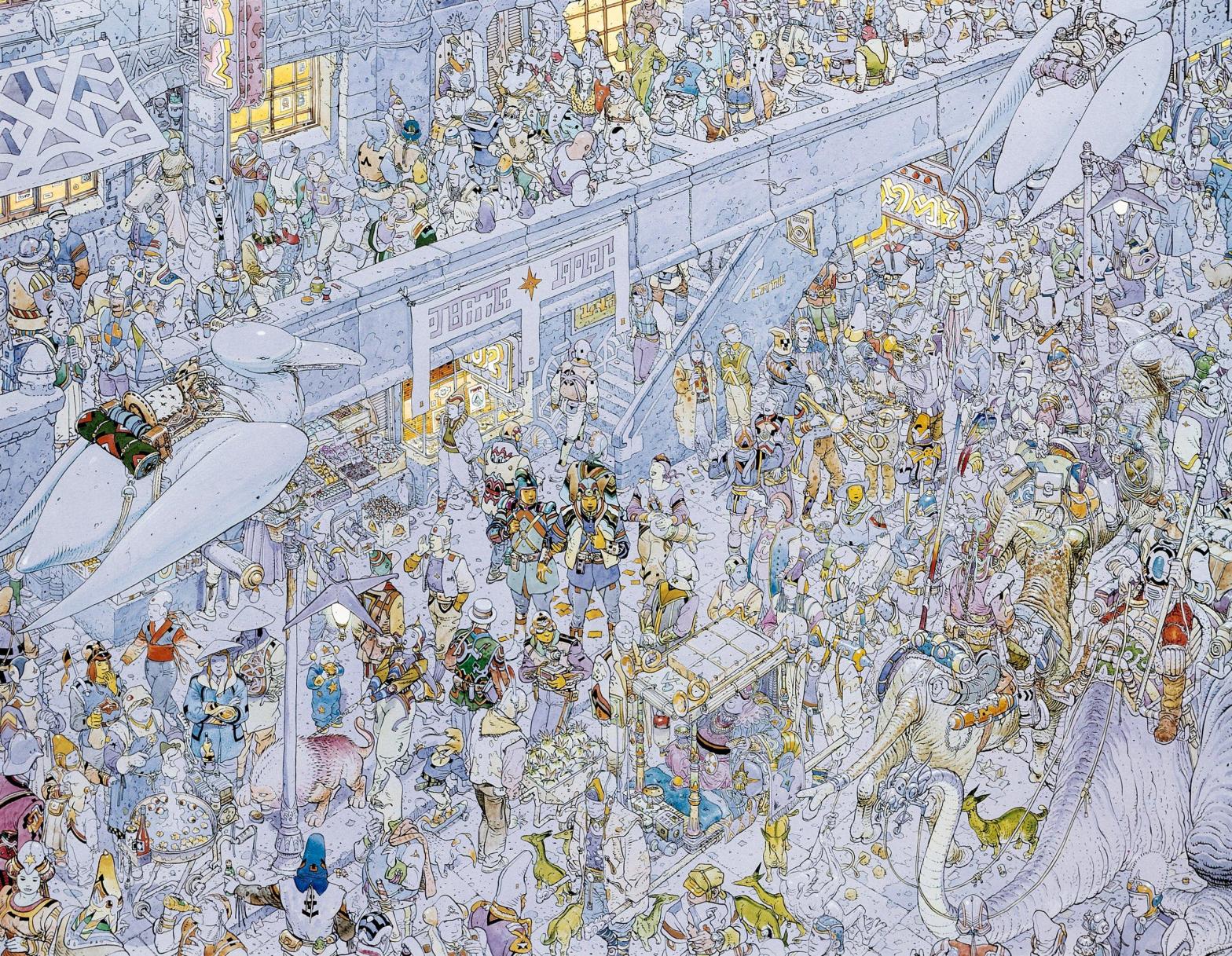
(Featured artwork is by Moebius, from a series of prints titled ‘La Cité de Feu’)

The Adventures of Hel and Edin, Chapter I

The Adventures of Hel and Edin

Chapter I

There were two of us. I, Hel, and the other, Edin. Both of us had learnt our professions and not much else at Wilchen, that indifferent place with one foot in civilisation and
the other in barbarism. The town stunk of indecision, right down to the Spiritual House our families sent us to for education. The House was in a perpetual cycle of being built up
then torn down, resulting in our Fathers having to usher us from domed wing to domed wing during the Season while workmen tore bricks from one wall to plug up a hole in another. They’d
usually christen their work with piss while they downed bottles of Schlimma, yelling obscenities at the monks who’d occassionaly brave one of the windows to peer at them. On one occassion
one of my ‘fellows’, some sunken-eyed brute, suffered a brick to fall on his head while trundling down the dusty halls that connected the wings of the place. He didn’t die, though his
ability to speak seemed to have leaked from his head along with a good deal of blood. He spent the rest of his time there doing menial work, which I thought was an improvement in his lot,
since he was previously accustomed to beating me up for spare change or amusement. That is, when Edin wasn’t around.

Edin was, and still is, the closest thing I’ve had to a friend. While I came from a tribe of clerks, he came from a religious House, though evidently minor. I can conjecture on his family
from Edin’s own character, that is, they are probably faithful, innocent to a fault, devotedly naive, lacking the ‘real stuff’ with which great clerics and prophets are born. He seemed the
only one worth the white cloth in the whole place, since the students were mostly thugs like our friend mentioned above, and the Fathers were mostly useless. None could touch Edin,
owing to his considerable bulk and readiness to use it. My station was usually behind that bulk, sometimes sallying forth to land a punch on his foe, who would usually pay me back later
with interest. As I said, Edin was innocent to a fault, which usually meant immediately forgiving whoever had crossed him, but it also meant that they would visit their revenge on me when
he wasn’t around.

When we weren’t fending off unwanted advances, we were holed up in a room that the Fathers called the library. Lectures and sermons were pitiful, and the tomes on the library bookshelves
weren’t much better, but there was precious little else to occupy our time with. Both Edin and I read with healthy appetite, though for different reasons: Edin, obviously, read books in
search of edifying discourses and theological summas, trying to make sense of the Billion yet One God which had haunted his curly straw head since he was young, and had given him what
amounted to a conscience. I, on the other hand, desired knowledge. All those with clerk blood desire it; one of my earliest memories was watching my father don his working clothes for the
day. The robe itself was unremarkable, some hessian coloured thing with ink splashed sleeves, but the true sight to behold were the ‘Scrolls of Art’, long strands of parchment which were
affixed to the back of his robe by the house slave using specially made brass clips. Upon these golden ribbons were the ‘Holy Case Names’, line after delightful line which gave proof to
his mastery of facts and penetrating quality of his mind. I cared not a jot for the ‘Cases’ themselves, the ‘Service to the Holiest Projekitor’, or ‘Loving Deed to Mother Amora, Shade and
Aspect of I/AM’, I cared only for the pride engendered in my heart knowing that my father was a man who knew a great deal, or at least enough to keep his family off the streets of muddy
Majoree. As I came to realise, even these marks of pride were common amongst clerks of his tribe, and even worse was that he was unable to complete his ‘Set’, that is, collect enough
‘Scrolls of Art’ to form a kind of cape. His Scrolls covered only half his back, making him appear like an angel with only one wing.

An angel he was not, but neither was he a devil. He was somewhere in the middle, just as our family was somewhere in the middle of the Tribal Order, lived somewhere in the middle of the
not-so-safe, not-so-dangerous clay caste life blocks which lined the streets leading up to the Paper Pit, the place my father worked. I remember him leaving one morning, dressed in his
robes and wearing those brass looking tubes that allowed him to achieve the perfect pen stroke, right down to the last monad of ink. He turned, hesitantly, to glance back at me as he took
his first step past the treshold, glancing back as if to implore help from his one and only son, a youth of ten. He looked ridiculous, his mouth quivering in want of some word of
farewell or affection while those pipes affixed to his face reached out to touch me. He looked as if some cruel metal God was gouging his eyes out, as if he was some poor servitor facing
face-first the sudden explosion of some overworked machine, as if I was the only one who could help him. Catching sight of his eye whites through the tubes, my heart turned to him. There
was nothing I could do. Nothing yet.

I devoted myself to studies, and in time the school master recognised that I was a suitable candidate for instruction at a Spiritual House, albeit one of the lesser ones, considering it
was already a privilege for a son of a tribesman to go near or even think of such places. My father took quiet joy in that privilege every night as we pored over yellowed scraps of text
which I had brought home from school, sighing half from exhaustion and half from pride, only taking a break to sip cold pepper tea, or to slap me awake after I drifted to sleep. Months upon
months of restless nights eventually led up to the Day of Scrutiny, held in the local guildhall. The Merchantmen allowed the use of the hall begrudgingly, a fact made clear to me as they
sneered and made mocking gestures at us, the candidates, with their kiddah pipes as they smoked in the acrid rain. Crossing the treshold, we were met with the iron face of some commerce God
whose name I cannot remember, his mouth agape so as to accept urgent correspondence or packages, which would be promptly sucked up into one of the many tubes which sprouted from his head
like tendrils to criss-cross the room and leave via holes in the walls. The Pneumatic God-Machine, whose Divine Act was so loud as to shake the hall most days, was left silent, and he
was made to suffer the presence of priests and acolytes who neither worshipped nor acknowledged him, beside the occassional puzzled look and knowing half-smile. As I took my first step into
this place, I glanced back at my father, one of a few figures who stood scattered in the rainfall, some of them clerks, some of them not, all of them expectant. I could see his eyes in full
this time. I hoped this was enough.

He had turned and left by the time the doors had been shut fast. I was left alone with the prospective herd, most of them chattering their teeth to warm themselves from the deluge which had
soaked them to the bone. Some had grouped into twos or threes, but most of us stood apart from each other. This void of anticipation was not helped by the patrolling priests, who walked
the boundaries of the entrance hall like a line of scowling heads. The rain had failed to cool the agitation of us candidates, and even the slightest brush of wet robe, a hint of vinegar
on breath, or even a strangled cough served only to crack our nerves. By the time the inner doors began to slowly wheel open, pushed wide by city guards bearing tridents and fire-sticks,
I was on the brink of a panic, noticeable even to those who stood near me. One by one they shuffled forward, bemused or silently smug in seeing me unable to move. I would have stayed there
to this day had I not felt that gentle touch of the one who I have already spoken of. A single knowing nod was enough to spur me on, and in the end we were both sent to the same House at
Welchin, whose state I have already described.

It may strike you as strange to hear I consider Edin the closest thing to, rather than simply a friend. Perhaps it is that ingrained reverence for difference of caste, no matter how slight,
or that almost idiotic benevolence which has, and perhaps always will, mystify me. Perhaps it is the fact that such a person as he is goes beyond that categorising tendency with which I and
all good knowledge grubbing clerks at heart, such as my father, employ as a matter of principle. ‘Friend’ for me means little more than an overly familiar acquaintance, a person who knows
your family and knows where you worship, but little else. Edin knew neither my Tribe nor their Gods, but seemed perfectly content with that. It was this confidence in me, rather than
anything else, which drove me to abandon the House when the need arose.

It was evening, and the two of us had been reading quietly for some time, when I noticed a hesitant head of one of our Fathers peer round the wall that divided our space from the rest of
the library. I could not make out his expression for his heavy hood and the dim lights of the place, but I could detect the anxiety in his voice when he called out to Edin to come to him.
Edin rose, walked away, and left my sight along with the Father. I heard whispers, words that seemed to drop from the mouth with some reluctance, followed by a sharp gasp, and then a final
hushed word that died away with steps leading out of the library. A moment later, I see Edin come around the corner, looking the same but not. He sat staring into space, like a mannequin
come to life, caught between muteness and speech. After a few silent seconds, I asked what had happened.

‘My father has died. They say he was murdered.’

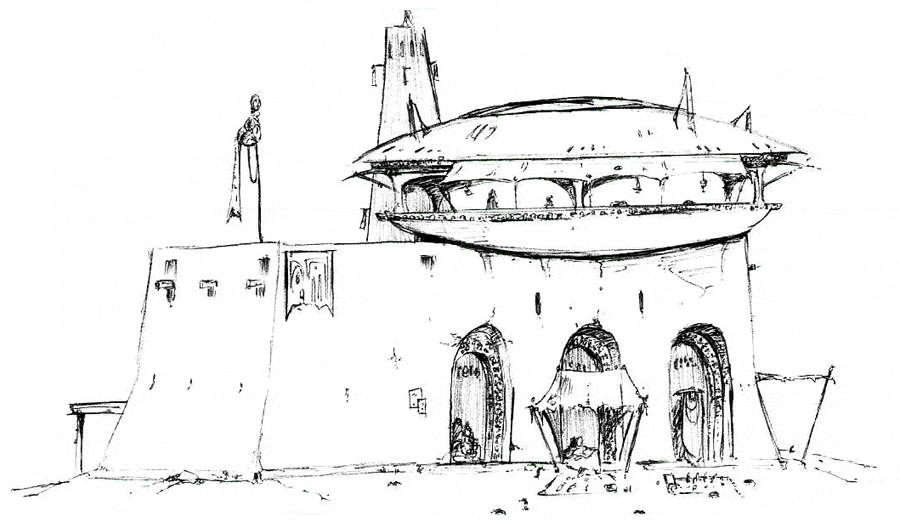
(Featured image is Morrowind concept art depicting a ‘Velothi temple’)

Games as a Matter of Life and Death (A Strange Monologue)

Games as a Matter of Life and Death; or, The Pitiful State of Would-be Gods

What matters the game? Why do I rage and hoot upon seeing some arrangement of dots on cubes of plastic?
why do I bury my face in my hands as my opponent poorly narrates the killing blow of some deaf and dumb man
against another deaf and dumb man? Why do I feel like some king toppled from his throne, which felt so secure only moments past?

I do not wish to generalise my feelings, only to intuit something with reference to certain ideas, theories or
notions that I assume, consciously or otherwise, in figuring out why I feel the way I feel. I will begin with what
I consider the main consuming problem which I believe most if not all actions I take and feelings I experience are tied to,
that of course being death. While I have not read in full the works of Ernest Becker, I feel inclined to agree with his
principal points, namely (and I apologise if I summarise wrongly) that death, rather than fluff like sex or parental envy,
is the principal source and driver of the existential angst which all men must suffer. The fundamental
existential problem, that being a lack of meaning in life and the universe, can be seen as the fatal end point of man’s
search for an enduring life beyond his own finite and fleshy own; man fears his own death, his own fleshiness, his own
creaturliness, and seeks out an enduring life in that beyond himself, from friends and family, to his city, to his nation, to his ideology,
to his God. When we follow this path and find nothing at the end, that is the source of terror and angst which makes up our suffering.

But this is elementary stuff, what does this have to do with games? Surely games (specifically strategy games, in my case) are an escape from
all this depressing navel gazing, a chance to take ‘time off’ from the dreary business of life. Not so, I say! For I argue that games are merely an exercise
in ‘going over’ those facts which we most desire to leave behind, a kind of pharmakon that decieves us as a remedy or drug to our disease, but which ends up
poisoning us in some way or another. I will use the example of the miniature wargame in my analysis, but I believe any points made by me are applicable to other forms of
game as well, be they card games, dice games, video games, etc.

As per Ernest Becker (I think!), man wishes to achieve some kind of immortality, that is, an escape from the consciousness of his own fleshy, creaturely, mortal
existence, an existence which must necessarily terminate in death. Games, particularly strategy games such as miniature wargames, are an apparent candidate for this
kind of immortality, as they are games which principally challenge a person’s intellectual faculties. In order to win at these games you have to be a good strategist,
that is, excel at observation, planning, decision making and prediction. When a person excels at these things, he briefly escapes the creaturely life of instinct and
fear, instead taking his seat on the Throne of God, taking a perfect omniscient view of the battlefield as he executes the right series of moves to win the game,
thereby highlighting his capacity as a rational being, thereby (again, briefly) placing the victor in the mind of God, that is, a purely calm, collected, and rational being.
To play at strategy games is to play at being God.

But what of chance, you say? Anyone familiar with miniature wargames is aware of the role chance has in the game, namely through the use of rolling dice to determine the outcome
of an action (for example a fight between two figures). Not only that, but chance plays a significant part in the mechanics of the game, as virtually any major action or event in
the wargame is determined with the roll of the dice. Does this chancy element not dispel the illusion of Godhood? Not so! For while a meditation such as this may dispel the illusion
of immmortality after the fact (a point I will talk on later), in the midst of the game, the element of chance serves only to enhance the divine quality of play! The point I am making
is that wargames are games of life and death, brutal contests of bloodshed and slaughter which end with either absolute victory or absolute defeat (with the miserable prospect
of a draw lying somewhere in between). Such primal and essential qualities of the play align the player’s consciousness with the divine bloodshed of ancient times, with the war stories
of the Iliad, where the Gods themselves would descend from Olympus to fight alongside mortal men. There is something analogous in the wargame, namely in the act of rolling the dice: upon
reflection dice throwing is subject to chance, that miserable, materialist notion which strikes me as saying something was caused by nothing (for what the hell is chance anyway? A nothing,
a trifle, I say). But, in the throes of the game, the player can imagine the throw of the dice as the dice being fought over by benevolent and malevolent gods, between one’s Guardian spirit
and a jealous daemon, the former wishing to show six beautiful dots, the other wishing to land on a pitiful one. When the former utterly triumphs the dice show six, when the latter utterly
triumphs the dice show one, with the various degrees of victory corresponding to the numbers shown on the dice (4 and 5 being close victories for our guardian, 2 and 3 close victories for
the daemon). It is like that old Christian notion of an angel and devil fighting over a dead man’s soul as it leaves his body.

What does this amount to then? It means that in the midst of the game, a successful dice throw means that we are, in a sense distinct from the previous one mentioned, Godlike. Or, more
properly, Blessed or ‘Kissed’ by the Gods, for we feel (even if it is only subconsciously) that we have been touched by kind and benevolent Gods, spirits who wish to do right by us, who
wish to see us happy and blessed and content and joyful, and who are (by implication) strong in the face of our enemies, for a six or five only comes up in the event of our guardian spirits
triumphing over the rival daemons who support our opponent. What this means is that when we triumph in the game, when we achieve victory through effective strategy and effective dice
rolling, we are twice blessed, twice divine, twice immortal: for not only are we blessed by God through the roll of the dice, but we are like unto God in the cultivation of those faculties
closest to Him, namely our rational faculties. For just a moment, we become immortal, and the limited, fleshy, finite materialness of our Human selves, so prone to fear, doubts, angst,
so utterly disturbed by the looming threat of failure and death, is brushed away like dust by the radiant sun of victory.

But, the obvious question arises: what if you lose? This piece started with a rather brief and pathetic description of despair in the face of defeat, and I believe anyone paying attention
to what I have just written will come to understand the psychological resonance of defeat. If you do not understand, I will state it plainly: to lose is to be damned. If, try as we might,
we rack our brains to devise some cunning stratagem to overcome our opponent, only to realise at the last moment that we overlooked some crucial detail, committing a mistake which
ultimately spells doom for our beleaguered soldiers, then we are violently met with the brutal fact of our own limitations, our own creatureliness, our own mortality: for only a mortal
could make such a mistake. The force of this revelation thrusts us from the Throne of God, tramples underfoot our reason, our sole link to the divine, and leaves us only with what we have
in common with the animals, namely, fear, uncertainty, and idiotic instinct.

Equally, if we continue to throw the dice, again and again, and yet they continue to show the horrid face of one and two, we can infer a number of things: one, that our guardian spirits
either hate us or ignore us, leaving our poor dice to be molested by the grinning and lecherous daemon of our opponent; two, that our guardian spirit does care for us, but he is too weak,
powerless to take on the daemon of our opponent, and is overpowered time and time again in the battle of the dice. From this we can assume that, when we fail to win our dice rolls, either
the Gods hate us or care not a jot for us, or they do care for us, but they are powerless in the face of our enemies. Either way, we are most certainly not blessed or ‘kissed’ by the Gods,
but rather we are damned to be hated by them, or rather to be hated by those Gods who possess true power, that is the Gods of our victorious opponent. In short, we are not twice blessed,
twice immortal, twice Godlike, but twice damned, twice cursed, twice hated, twice dead, twice Human.

But why is this? If you have been reading this piece so far, you have probably arrived at some questions. These probably include ‘What the hell is he talking about?’, but they may also
include ‘Why does he think this? Why is he thinking about games in this way?’ My answer to this ultimately links back to my claim that games are a kind of pharmakon, that is, a drug or
substance which can be consumed but which may function either as remedy or poison. The truth (as I see it) is that games (among many other things) are one of many kinds of pharmakon, things
or activities that we seek after and engage with in order to alleviate our own sense of mortality and finiteness by securing ourselves a little piece of immortality. The means by which this
is achieved by miniature wargames I have already outlined above. The problem here is obviously the vicious binary of victory versus defeat. If we lose, the pharmakon turns poison, and the
game, which previously seemed so promising, so alluring in its evocation of Homeric divine bloodshed, offering laurel crowns for the victor, is now seen as but a miserable reminder of our
own human limitations and faults. Remember my reference to chance, rather than divine intervention, as the cause of the outcome of dice rolls? After the intensity of the game, the losing
player slowly sheds that puerile fantasy of guardian spirits, and takes on the more mature (more miserable!) outlook of the dice rolls being a product of chance. What a terrible discovery!
Mere chance was the barrier to victory? If only the rolls went differently, the game could have been much different. Such thoughts are ample evidence of my claim that the game pharmakon
turns to poison in the event of defeat, and yet there is an interesting point here: mere chance was the barrier to defeat? My reasoning is limited, yes, but it is something that can be
worked on, refined, improved, elevated. Ultimately, within that concentrated ball of poison lies the seed of promise, namely the twofold promise of improved strategy and favourable chance.
It is this seed of promise which makes us return to the game time and time again. We may rage and hoot, as previously described above, at the event of a loss, but we will almost always
return, for the pharmakon never loses its sheen, and poison can be flushed from our system. Indeed, what other choice do we have? Is it better to sit in mere existence, and not attempt the
game? Either way we will be reminded of our mortality, but with the game, the pharmakon, lies the promise of remedy, the promise of victory, which will make all the poisonous defeats
worthwhile.

But is that really the case? Let us examine what happens when the player achieves victory, and the pharmakon of the game renders itself up as remedy to our fleshiness, bestowing a little
glowing piece of Godhood to be enjoyed for the space of an hour or so. On that first form of immortality, namely that achieved through strategy, it is quite obvious to me that the passage
of time puts such confidence to doubt: certainly, I may have won that game well enough, but what will happen in the future? Will my skills wane? What if I face a stronger opponent? There
is nothing more terrible for a man than having to sit down and think about himself for five minutes. Equally, the victor will come to the same realisation of the dice throws that his
defeated opponent comes to, that is, the dice throws were not the product of some theological conflict, but rather the product of mere chance. This is obviously disconcerting, since we
love to vainly bask in the divine light expelled from a six sided die. This undermining of the two immortalities of victory ultimately reveals the converse effect the pharmakon has on the
victor compared to the loser: the defeated man swallows the poison pill, but within his insides springs forth the seed of promise and hope, and he returns to the game again, eager to
acquire his own little piece of immortality. Conversely, the victor drinks deep the lichor of remedy, only to discover that it turns to poison, and serves only to remind him of his own
limitations, his faults, his own mortal nature. Because of this, the victor must return to the game again, as it is not enough to have one piece of God in his possession. He needs a
treasury.

Not enough? But why? Why is man so intent on this? Why does man want to be God, or at least, wants to be like unto God and blessed by Him? I think this leads into an interesting point
that ultimately provides little comfort to me, but at least puts things into perspective. It seems to me that we are all pitiful slaves to death. By this I do not mean that we are merely
subject to his rules, but rather that we possess such great fear of death to the point that it infects all aspects of life. This is why we so eagerly rush to the comforting arms of the
pharmakon, which of course need not be miniature wargames, but pretty much anything else that man occupies himself with in his leisure time: philosphy, history, the arts, sports,
travelling, socialising, whatever else you can list. Within these things lie the converse relationship of victory and defeat: to face defeat in these things entails a return; to face
victory in these things leaves you wanting more. Thus we continue this cycle, time and time again, returning to our favourite pastimes like a drunkard returns to the bottle.

But is that it? As I said before, this discovery leaves little comfort to me, but there is at least a little comfort to be had. I take comfort in that others seem to have not only
recognised these facts, but at least offered up thoughts or even solutions. Kierkegaard and his three stages of man seems to chime in here, since what I am describing may only be
the description of a certain stage of man, namely that of the hedonist (which we may call here the hobbyist). Such a description does not dismiss the possibilities of other means of life,
namely the ethical and spiritual stages which make up the other stages of man in his conception. Another figure that comes to mind is Nietzsche, particularly his notion of the ubermensch.
In this piece I have time and time again emphasised the wargame functioning as a means of achieving temporary Godhood, namely same kind of transcendental state which puts him up and above
the mere material world of frightened and insecure mortals. It is obvious that if this is why people actually play these kinds of games, then the motivation of the player is rooted in this
kind of natural aversion to the mere materiality and finiteness of the world, manifesting itself in that terror of death described by Becker. But surely Nietzche’s ubermensch, a figure so
utterly of THIS world, and no other, would experience nothing of the sort when playing games of this kind. Whether he would play such games is another question, but if he did play such
games, he would not do so out of a desire to escape the mere worldly state of finite human existence, desiring to be some kind of would-be God that transcends the fleshy, creaturely state
of being he occupies through the pharmakon of the game. Another obvious example is the Buddha, who would probably ask why you waste time on some game that only provides temporary (that is, impermanent) access to the divine, a divinity which isn’t actually divine anyway (namely because Buddhism is non-theological, that is, possesses no Godhead, at least nothing like the Abrahamic one). If only becoming Kierkegaard’s knight of faith, or Nietzsche’s ubermensch, or achieving Nirvana was so easy!

While these writings may strike the reader as utterly strange and preoccupied with trivialities, I think that there is something worthwhile in critically thinking through activities such
as strategy games which take up so much of our time and our rational and emotional capacity. We are rightfully concerned about the serious business of life (politics, wars, economy, etc.),
but I believe it is best to leave a little critical thought about the leisurely side of life, and particularly in understanding how the facts of life do not stop at leisure, and in fact
discovering the seemingly innocent activities of recreation may be intertwined with the existential conundrums which we have faced since time immemorial.

The Pillar

The sediment made us sick.

The wandering delta streams, the stench of endless green,

The mixing play of words, wine and bloody spray

Flowing into a slow drop of day.

Maladies hummed like reeds by the bank.

Old-young, rich-poor, pale-burnt,

All come and drink a flower dew,

The falling waves of purple-golden crash

Upon them with wolfish lion hue.

The eyes dart, the hands tremble, the mind does start

With schizoid blooming thoughts. We looked upon it,

And saw but a lively death.

We turned away and sought elsewhere.

We wandered through a desert flat,

The horizon line ‘tween spherical blue

And blinding white.

We built a pillar in the middle of everything.

We mixed our thought and speech with

ivory shafts and mannered leaves.

We sat on the plinth for days, months, years.

We stared at the circle face of the sun.

We knew nothing. Our eyes cataract, limbs thin sticks,

Our brains devoid like the desert flat we so, so praised.

We saw but a deathly life.

We turned away and sought elsewhere.

Create your own website, free on WordPress.com.Create your own website.
Start free