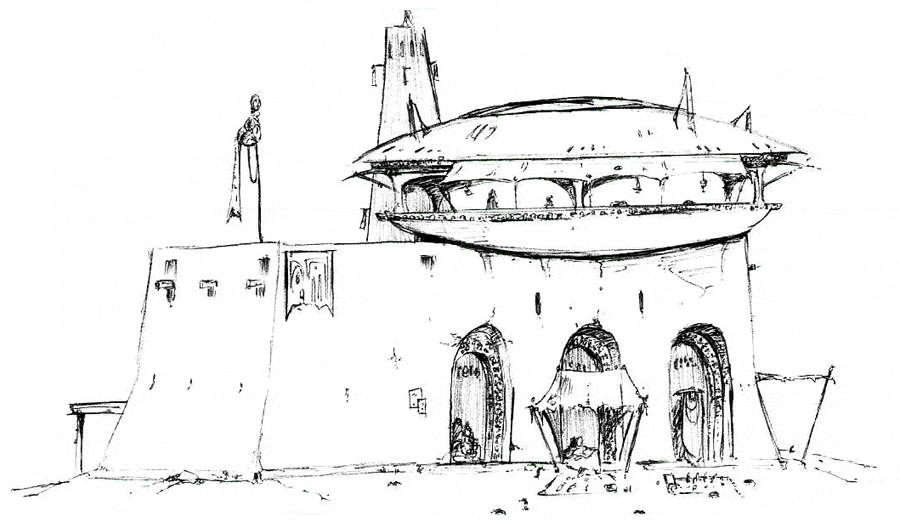
The Adventures of Hel and Edin
Chapter I
There were two of us. I, Hel, and the other, Edin. Both of us had learnt our professions and not much else at Wilchen, that indifferent place with one foot in civilisation and
the other in barbarism. The town stunk of indecision, right down to the Spiritual House our families sent us to for education. The House was in a perpetual cycle of being built up
then torn down, resulting in our Fathers having to usher us from domed wing to domed wing during the Season while workmen tore bricks from one wall to plug up a hole in another. They’d
usually christen their work with piss while they downed bottles of Schlimma, yelling obscenities at the monks who’d occassionaly brave one of the windows to peer at them. On one occassion
one of my ‘fellows’, some sunken-eyed brute, suffered a brick to fall on his head while trundling down the dusty halls that connected the wings of the place. He didn’t die, though his
ability to speak seemed to have leaked from his head along with a good deal of blood. He spent the rest of his time there doing menial work, which I thought was an improvement in his lot,
since he was previously accustomed to beating me up for spare change or amusement. That is, when Edin wasn’t around.
Edin was, and still is, the closest thing I’ve had to a friend. While I came from a tribe of clerks, he came from a religious House, though evidently minor. I can conjecture on his family
from Edin’s own character, that is, they are probably faithful, innocent to a fault, devotedly naive, lacking the ‘real stuff’ with which great clerics and prophets are born. He seemed the
only one worth the white cloth in the whole place, since the students were mostly thugs like our friend mentioned above, and the Fathers were mostly useless. None could touch Edin,
owing to his considerable bulk and readiness to use it. My station was usually behind that bulk, sometimes sallying forth to land a punch on his foe, who would usually pay me back later
with interest. As I said, Edin was innocent to a fault, which usually meant immediately forgiving whoever had crossed him, but it also meant that they would visit their revenge on me when
he wasn’t around.
When we weren’t fending off unwanted advances, we were holed up in a room that the Fathers called the library. Lectures and sermons were pitiful, and the tomes on the library bookshelves
weren’t much better, but there was precious little else to occupy our time with. Both Edin and I read with healthy appetite, though for different reasons: Edin, obviously, read books in
search of edifying discourses and theological summas, trying to make sense of the Billion yet One God which had haunted his curly straw head since he was young, and had given him what
amounted to a conscience. I, on the other hand, desired knowledge. All those with clerk blood desire it; one of my earliest memories was watching my father don his working clothes for the
day. The robe itself was unremarkable, some hessian coloured thing with ink splashed sleeves, but the true sight to behold were the ‘Scrolls of Art’, long strands of parchment which were
affixed to the back of his robe by the house slave using specially made brass clips. Upon these golden ribbons were the ‘Holy Case Names’, line after delightful line which gave proof to
his mastery of facts and penetrating quality of his mind. I cared not a jot for the ‘Cases’ themselves, the ‘Service to the Holiest Projekitor’, or ‘Loving Deed to Mother Amora, Shade and
Aspect of I/AM’, I cared only for the pride engendered in my heart knowing that my father was a man who knew a great deal, or at least enough to keep his family off the streets of muddy
Majoree. As I came to realise, even these marks of pride were common amongst clerks of his tribe, and even worse was that he was unable to complete his ‘Set’, that is, collect enough
‘Scrolls of Art’ to form a kind of cape. His Scrolls covered only half his back, making him appear like an angel with only one wing.
An angel he was not, but neither was he a devil. He was somewhere in the middle, just as our family was somewhere in the middle of the Tribal Order, lived somewhere in the middle of the
not-so-safe, not-so-dangerous clay caste life blocks which lined the streets leading up to the Paper Pit, the place my father worked. I remember him leaving one morning, dressed in his
robes and wearing those brass looking tubes that allowed him to achieve the perfect pen stroke, right down to the last monad of ink. He turned, hesitantly, to glance back at me as he took
his first step past the treshold, glancing back as if to implore help from his one and only son, a youth of ten. He looked ridiculous, his mouth quivering in want of some word of
farewell or affection while those pipes affixed to his face reached out to touch me. He looked as if some cruel metal God was gouging his eyes out, as if he was some poor servitor facing
face-first the sudden explosion of some overworked machine, as if I was the only one who could help him. Catching sight of his eye whites through the tubes, my heart turned to him. There
was nothing I could do. Nothing yet.
I devoted myself to studies, and in time the school master recognised that I was a suitable candidate for instruction at a Spiritual House, albeit one of the lesser ones, considering it
was already a privilege for a son of a tribesman to go near or even think of such places. My father took quiet joy in that privilege every night as we pored over yellowed scraps of text
which I had brought home from school, sighing half from exhaustion and half from pride, only taking a break to sip cold pepper tea, or to slap me awake after I drifted to sleep. Months upon
months of restless nights eventually led up to the Day of Scrutiny, held in the local guildhall. The Merchantmen allowed the use of the hall begrudgingly, a fact made clear to me as they
sneered and made mocking gestures at us, the candidates, with their kiddah pipes as they smoked in the acrid rain. Crossing the treshold, we were met with the iron face of some commerce God
whose name I cannot remember, his mouth agape so as to accept urgent correspondence or packages, which would be promptly sucked up into one of the many tubes which sprouted from his head
like tendrils to criss-cross the room and leave via holes in the walls. The Pneumatic God-Machine, whose Divine Act was so loud as to shake the hall most days, was left silent, and he
was made to suffer the presence of priests and acolytes who neither worshipped nor acknowledged him, beside the occassional puzzled look and knowing half-smile. As I took my first step into
this place, I glanced back at my father, one of a few figures who stood scattered in the rainfall, some of them clerks, some of them not, all of them expectant. I could see his eyes in full
this time. I hoped this was enough.
He had turned and left by the time the doors had been shut fast. I was left alone with the prospective herd, most of them chattering their teeth to warm themselves from the deluge which had
soaked them to the bone. Some had grouped into twos or threes, but most of us stood apart from each other. This void of anticipation was not helped by the patrolling priests, who walked
the boundaries of the entrance hall like a line of scowling heads. The rain had failed to cool the agitation of us candidates, and even the slightest brush of wet robe, a hint of vinegar
on breath, or even a strangled cough served only to crack our nerves. By the time the inner doors began to slowly wheel open, pushed wide by city guards bearing tridents and fire-sticks,
I was on the brink of a panic, noticeable even to those who stood near me. One by one they shuffled forward, bemused or silently smug in seeing me unable to move. I would have stayed there
to this day had I not felt that gentle touch of the one who I have already spoken of. A single knowing nod was enough to spur me on, and in the end we were both sent to the same House at
Welchin, whose state I have already described.
It may strike you as strange to hear I consider Edin the closest thing to, rather than simply a friend. Perhaps it is that ingrained reverence for difference of caste, no matter how slight,
or that almost idiotic benevolence which has, and perhaps always will, mystify me. Perhaps it is the fact that such a person as he is goes beyond that categorising tendency with which I and
all good knowledge grubbing clerks at heart, such as my father, employ as a matter of principle. ‘Friend’ for me means little more than an overly familiar acquaintance, a person who knows
your family and knows where you worship, but little else. Edin knew neither my Tribe nor their Gods, but seemed perfectly content with that. It was this confidence in me, rather than
anything else, which drove me to abandon the House when the need arose.
It was evening, and the two of us had been reading quietly for some time, when I noticed a hesitant head of one of our Fathers peer round the wall that divided our space from the rest of
the library. I could not make out his expression for his heavy hood and the dim lights of the place, but I could detect the anxiety in his voice when he called out to Edin to come to him.
Edin rose, walked away, and left my sight along with the Father. I heard whispers, words that seemed to drop from the mouth with some reluctance, followed by a sharp gasp, and then a final
hushed word that died away with steps leading out of the library. A moment later, I see Edin come around the corner, looking the same but not. He sat staring into space, like a mannequin
come to life, caught between muteness and speech. After a few silent seconds, I asked what had happened.
‘My father has died. They say he was murdered.’
(Featured image is Morrowind concept art depicting a ‘Velothi temple’)

